Sunday, February 23, 2014

A Significant Milestone

My home church (the St. Nicholas Orthodox Church) covered in snow.
Photo by Gilmore.

This morning, I attended the Liturgy of the Orthodox Christian church. It was a very special Liturgy for me, because in the middle of the ceremony, they accepted me to become a "catechumen". I stood in front of the church hall.  The priest laid his hand on my head and said a few certain words, and then everyone at the ceremony prayed for me. As I walked back to my spot, I was moved to tears. It was such a sacred and touching moment. In a sense, I have been a catechumen already since last year, but only now it's official. What does it mean?

According to the OrthodoxWiki: "A catechumen is one who is preparing for baptism in the Church. In modern usage, catechumen can also refer to one who is preparing for chrismation (or another form of reception) to be received from a heterodox Christian communion. In the ancient Church, the catechumenate, or time during which one is a catechumen, often lasted for as much as three years and included not only participation in the divine services but also catechesis, formal instruction from a teacher, often the bishop or appointed catechist. Catechumens are understood to be Christians upon beginning their catechumenate, and should they die before baptism, they are traditionally given an Orthodox funeral."

 «An angel from heaven appeared to him and strengthened him...»


The catechumenate (Russian: оглашенные) period is a long process. At times, I have been frustrated, and I've been asking myself: "Why they make it so difficult and slow to join the church?" I have had to be patient... God has strengthened me by sending me an "angel" and spiritual guide (cf. the Gospel of Luke 22:43). Without her, I would have given up long ago. Like she used to say, "We are instruments in the hands of God". Amen to this. Afterwards we can understand the Divine providence. No matter how you feel, there is the guidance of God behind it all.

Today, I also found a "godfather" (Finnish: kummi, Russian: крёстный) for me, and he even lives on the same street as I do. That's really great because I had no idea who could be my godfather when I am going to be accepted to the church on April 19 (may God grant it). Now all these problems seem to have been solved...

Indeed, this was a great day for me! Thank God for the guidance, in spite of my weak faith. Thanks also to my "Russian angel" and to my friends.

Peace and blessings to all. (^—^)

Teisuka

The St. Nicholas Orthodox Church in Vaasa. Православная церковь
Св. Николая Чудотворца в Вааса. The church was completed in
1866, and was originally built for the Russian population of Vaasa.
Photo by Teisuka.

Monday, February 17, 2014

A Parcel from Russia

The Vladimirskaya icon, as Russians call it.

Last week, I received a big parcel from my dear Russian friend. The parcel included many kinds of items: a great religious book called Everyday Saints and Other Stories written by Archimandrite Tikhon (Shevkunov), four CD's full of Russian Orthodox music sung by the Sretensky monastery choir, three T-shirts (very beautiful), sacred images (out of which one was a refrigerator magnet), an Orthodox bookmark, the Vladimirskaya icon, and a wonderful handmade Easter egg. Wow!

This was the best birthday gift I have ever gotten in my life and it made me really happy. I feel that the whole content of this parcel is caused by the guidance of God. I mean, I can recognize "the God's hand" or Divine providence in these gifts and it strengthens my weak faith. Thank you very much, my dear friend. Большое спасибо, мой ангел! You really are an angel sent to me by God. (^—^)

Blessings to all of my friends!

Teisuka

A handmade Russian Easter egg.

One of three Russia T-shirts (all different).

Four CD's, full of Russian Orthodox music sung by
the Sretensky monastery choir.

A religious book (Everyday Saints and Other Stories),
sacred images, a refrigerator magnet, and a bookmark.

Wednesday, January 22, 2014

Love Beautify the World


After a long time, I wrote a poem.

What a day for you whose heart is in love,
the sun is shining, the world is in harmony,
the unspeakable peace lives in your soul,
pure joy and gratitude – no shadows at all.
Everyone, everywhere is smiling, is happy,
you see all the beauty as for the first time,
all is clear, all is pure and white –
blessed are those who are in love.

Teisuka (January 22, 2014)

Saturday, January 4, 2014

Long Range Patrol – the Best Finnish War Film for Years

Kaukopartio (Long Range Patrol) movie poster.

The film crew and some cast members. The premiere night
party at the museum. Sitting in the foreground, a film
director Harri J. Rantala (a submachine gun in his hands)
and a costume designer / a makeup artist Sanna Panula.
Photo by Teisuka. (Click the photo to see it bigger.)

This time, I tell something about a new Finnish war film called Kaukopartio (English: Long Range Patrol), written and directed by Harri J. Rantala, starring Eerik Kantokoski, Ali Ahovaara, Hannu Rantala, Eeva Putro, Kalevi Haapoja, and Kristiina Karhu. The world premiere was held on December 27th 2013 in the Civil Guard and Lotta Svärd Museum. Earlier, the Finnish crew also filmed one scene in the museum.

First of all, I want to explain the term "long range patrol" (Finnish: kaukopartio, Russian: дальний патруль, Chinese: 長距離巡邏, Japanese: ロングレンジパトロール), if some of my readers doesn't know that. Long-range reconnaissance patrols, or LRRPs (pronounced "Lurps"), are small, heavily armed long-range reconnaissance teams that patrol deep in enemy-held territory.

In Finland, long-range patrols were especially notable in the World War II. These units penetrated Soviet lines and conducted recon and destroy missions. During the trench warfare period of the Continuation War (1941-1944), long-range patrols were often conducted by special Finnish sissi troops. In English, a Finnish word "sissi" means something like patrolman, partisan, or commando.

The Finnish movie called Long Range Patrol is not a typical war film. I mean, it's not a heroic story. It shows the cruel and nasty side of war. To be exact, this movie tells about the Finnish war crime during the Continuation War. In 1943, a Finnish long-range patrol (three young men) makes a campaign to the Soviet Union, and they get a mission to bring a prisoner of war. The mission fails badly, and the end result is ugly. There is one truly shocking scene in the film. Despite this, the two soldiers receive a medal of honor at the end.

In my opinion, Long Range Patrol is a good movie in many ways: screenplay, theme, directing, acting, setting, costume design, cinematography, editing – all is well done. The only minus side is a little bit scruffy picture quality (not sharp enough). The running time is only 60 minutes, so the movie could be a little longer, too. Anyway, the shots or scenes are long and lingering, and I like that style.

For me, the movie raised up many questions, but it's just a good thing. The story is not too simple, not too obvious, and black and white. You have to use your brains and think – think hard. Long Range Patrol gives you a food for thought, indeed. What really happens? What's going on? Are there heroes at all, or are they all just an "inglorious bastards"? Well, for my part I believe, there are also heroes and good men in the war, but this film don't tell about them.

All in all, Long Range Patrol is a brave Finnish film. Brave, because we must have courage to talk about the war crimes too, and not only about the heroic acts. I dare to say that Long Range Patrol is the best Finnish war film since Ambush (Finnish: Rukajärven tie) from the year 1999.

You can find the official Kaukopartio website by clicking here. Facebook site is also available to everyone, please click here. Thanks for supporting the Finnish cinema – kiitos! (^—^)

Teisuka

A real Finnish ski patrol during World War II.

Friday, December 27, 2013

Who is Always Stalking at the Window?

You're calmly walking on the yard, but something seems strange. It's like... someone is staring at you! Who is it? The yard is empty. Suddenly, a curtain moves in the neighbor's window. Is it the neighbor's grandmother who is watching you? No, it's not your neighbor's grandma, but something much hairier... The Cat! ( ̄ー ̄)

I found these hairy little "stalkers" from the Finnish humor site, and I want to share them with my friends around the world. I hope these funny pictures makes you laugh. I wrote the captions myself.

Happy New Year to everyone! According to Chinese zodiac, 2014 is the Year of the Horse. Woohoo! (^—^)

Teisuka

The black spy next door.

Just a curious little kitten.

If you are lazy, a chair makes it easier.

Tiny little stalkers.

"Aww, how lovely little bird. We all would like to eat you."

Now who is watching who?

A cute and shy little stalker.

A case-hardened old stalker.

A little accident at work.

"See, I can sit like a man."

Some stalkers wants to be seen.

OMG, this one is a murderer too!

A long-term stalker with his stalking chair.
Tools facilitate the work.

"Damn window blinds! I'm too fat for this shit!"

"Whoops... I got caught."

Ouch!

Saturday, December 14, 2013

A Famous Russian War Historian Visited the Museum

A Russian war historian Artem Drabkin and his interpreter Svetlana
in the museum. In the background, the blue and white Finnish
swastika. Photo by Teisuka.

Last Sunday, a Russian war historian Artem Drabkin (Артём Драбкин) from Moscow visited the museum, my current workplace. I had the privilege to be his guide. In addition to Artem, there were two other people: Artem's interpreter, a Russian woman called Svetlana (Светла́на), and their Finnish host and organizer, Matti. We walked around the museum about 90 minutes, and I told about the objects in the exhibition and the Finnish war history, especially about the Lotta Svärd organisation and the Finnish women at war.

"Very interestings place. Spasibo" (thank you), Artem said when the tour was over. Then we shook hands and said "dosvidaniya" (until we meet again) to each other. Both Artem and Svetlana were nice and kind people, as Russians used to be. For me, this was a wonderful opportunity to meet a famous Russian war historian. I'm just reading his book called The Continuation War from the perspective of the Red Army (Finnish: Jatkosota puna-armeijan silmin). Excellent book, including a lot of rare photographs.

In Finland, Artem Drabkin also interviewed the Finnish veterans and Lottas of World War II. In my opinion, this kind of intercultural and international cooperation is remarkable and ground-breaking. Seventy years ago we (Finns and Russians) were enemies but now we are friends.

Artem Drabkin is the creator of a website devoted to the oral history of World War II on the Eastern Front. Like my Russian friend Victor says, Drabkin's project I remember is very interesting and important as it helps to keep our memory of WWII. Drabkin is recording interviews of war veterans in Russia, Germany, and Finland. At the moment, there are more than 2000 interviews in his collection. Artem's website is available in English and Russian at http://english.iremember.ru/

You can find the Russian Wikipedia article by clicking here.

Lotta Svärd and the Finnish Swastika


Finally, I want to tell something about the Finnish swastika, because it appears in my photos. The Finnish swastika has nothing to do with Nazism, just like a wholesome Finnish patriotism has nothing to do with that sick ideology. (All of my friends know that I hate Nazism more than any other "ism".)

In Finland, the swastika was often used in traditional folk art products, as a decoration or magical symbol on textiles and wood. It is thousands of years old symbol of luck. The swastika was also used by the Finnish Air Force until 1945, and is still used in air force flags.

The Finnish Air Force uses the swastika as an emblem, introduced in 1918 (the Nazi swastika came at a later date, in 1920). The type of swastika adopted by the air-force was the symbol of luck for the Swedish count Eric von Rosen, who donated one of its earliest aircraft.

Also a design by the artist Akseli Gallen-Kallela from 1918, the Cross of Liberty has a swastika pattern in its arms. Gallen-Kallela used the Finnish swastika in his early works, for example the painting called The Aino triptych (Finnish: Aino-triptyykki) from year 1889.

 The Aino triptych, an old Finnish painting by Akseli
Gallen-Kallela, 1889. Click the image to see it bigger.


The Lotta Svärd emblem was designed by Eric Wasström
in 1921. It includes four heraldic roses and a swastika.
In Finland, the swastika is an ancient symbol of luck.

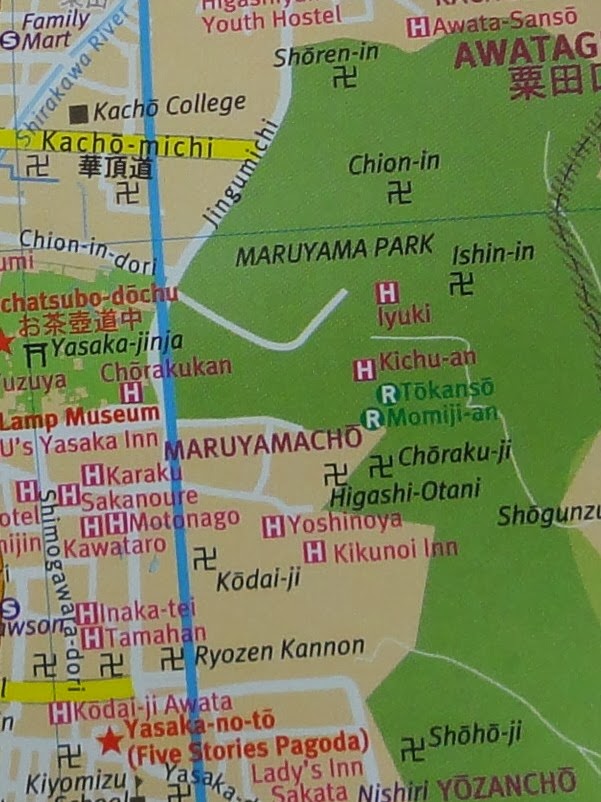
On Japanese maps, a swastika is used to mark the location of a Buddhist
temple. 日本では、卍は、寺院などの地図記号として使用されている。

The swastika was used by Lotta Svärd, a Finnish voluntary national defence organisation for women between 1921 and 1944. The organisation was religious-patriotic, unarmed and non-political. In 1944, there were more than 240 000 Lottas in Finland. About 90 000 Lottas served their country at the front during the wartime 1939-1945. They worked in hospitals, at air-raid warning posts and other auxiliary tasks in conjunction with the armed forces. The motto of the organisation was "religion, home and fatherland" (specifically in that order; the mentioned religion was the Lutheran Christianity).

In addition, the swastika is a good symbol in Buddhism, Hinduism, and Jainism. Originally, it's a symbol of the Sun. The Buddhist sign has been standardized as a Chinese character 卍 (wàn) and as such entered various other East Asian languages such as Japanese where the symbol is called 卍 (manji) or 卍字 (manji). The swastika is included as part of the Chinese script in the form of the character 萬 (wàn). In East Asian countries, the left-facing and horizontal swastika often marks the location of a Buddhist temple on maps.

P.S. I also add here some other new photos from my workplace, taken this week.

Teisuka
museum assistant

Me in the work. Last Wednesday, there was a Christmas event in the museum.
All workers were dressed in the old costumes. I used the Finnish military
uniform from the time of World War II (reconstruction, not original).

Me and Marshal Mannerheim (a lifelike wax figure, 194 cm
in length) in the headquarters, a railway carriage. This is my
favorite room in the museum. Click the photo to see it bigger.

Monday, November 25, 2013

Gustaf Mannerheim – the Greatest Finn of All Time?

Carl Gustaf Emil Mannerheim (1867-1951) was a legendary Finnish
military leader and statesman.

Every nation needs its heroes and myths, the great men and women of the history. We Finns have one great person above all. In 2004, Gustaf Mannerheim was voted the greatest Finnish person of all time in the Great Finns ("Suuret suomalaiset") contest. Who was this man and what did he do? I want to introduce Mr. Mannerheim to my friends around the world. Welcome to the journey to the Finnish history!

Baron Gustaf Mannerheim is a fascinating, even mythical, figure. He served as the military leader of the "Whites" in the Finnish Civil War, the Regent of Finland (1918-1919), the Commander-in-Chief of Finland's Defence Forces during World War II, the Marshal of Finland, and the sixth President of Finland (1944-1946). Besides his mother tongue, Swedish, Mannerheim learned to speak Finnish, Russian, French, German and English. He also spoke Polish and Portuguese and understood some Mandarin Chinese.

Mannerheim was an officer and a gentleman, a soldier and a war hero, a skillful politician and a diplomatic statesman, a patriot, but never a nationalist. In addition to that, he was an adventurous explorer, a warm-hearted supporter of humanitarian causes, a big-game hunter, a well-travelled cosmopolitan and a generous host in his own home. He possessed one quality common to all great men, an immense will-power that carried him through all the difficult times.

I have to say, the more I learn about Mannerheim, the more I respect him. It is fair to say that Mannerheim saved Finland three times: in 1918, in 1940 and in 1944 – always during wartime. Even Stalin respected and admired Marshal Mannerheim. Stalin told a Finnish delegation in Moscow in 1947 that the Finns owe much to their old Marshal. Thanks to Mannerheim, Finland was not occupied.

Mannerheim is a controversial but mostly loved person. Some people (for example communists) hate him and say that he was a fascist and a friend of Adolf Hitler's. That is a treacherous lie. In fact, Mannerheim was a monarchist and he hated Nazism and "the German barbarism". However, during World War II, Finland needed Germany's assistance against the Soviet Union. Germany was Finland's only "ally" or brother-in-arms in that situation, and the Germans also needed Finland when they started their Operation Barbarossa in 1941. It was a "relationship of mutual exploitation".

 
Anastasia Arapova, a Russian wife of Mannerheim.

Anastasie and Sophie, daughters of Anastasia and Mannerheim.

Youth in Russia


Carl Gustaf Emil Mannerheim was born on June 4th 1867 at Askainen in Finland. He served 30 years in the Imperial Russian Army (1887-1917). At the time, from 1809 to 1917, Finland was a nominally autonomous part of the Russian Empire. It was called The Grand Duchy of Finland. Mannerheim received his military training at the Nikolaevski Cavalry School in St. Petersburg.

During the Russian years of Mannerheim, many remarkable things happened to him, including service in various regiments of the Imperial Guards, marriage with a noble Russian lady called Anastasia Arapova (Анастасия Николаевна Арапова) in 1892, participation in the Russo-Japanese War of 1904-1905, an extended reconnaissance journey across Asia and China on horseback in 1906-1908, and the First World War.

Mannerheim and Anastasia had two daughters, Anastasie and Sophie. Both were born in St. Petersburg, Russia. The third child, a son, was stillborn. This tragedy probably destroyed the marriage once and for all. Mannerheim separated from Anastasia Arapova in 1902, and they divorced in 1919. Mannerheim never married again. Anastasia died in Paris in 1936.

Mannerheim loved Russia but he hated Bolshevism (communism). He said, "the Bolsheviks destroyed the Russia I loved". After the Bolshevik revolution in 1917, General Mannerheim returned to Finland.

Mannerheim himself summed up his Russian period in the following words in his memoirs: "...and when I looked back on that time that I had spent in the uniform of the Tsar I had to admit with gratitude that my expectations had been totally fulfilled. I had entered higher circles and enjoyed broader perspectives than I could ever have done in Finland in those last decades of the 19th century. Each stage in my military career had been extremely rewarding, and to cap it all I had had the good fortune to belong to, and even to command, an elite force that had good officers and an excellent esprit de corps [the morale of a group]. The act of leading such troops, in peace and war, had given me the utmost satisfaction. I had seen much that was of interest on two continents." (Otava 1951. Part I, pp. 236-237.)

After the October Revolution in Russia, the Finnish government declared independence on December 6th 1917. The next year, a horrible Civil War broke out in Finland.

Mannerheim at Aksu in China in 1907. He was also an adventurous explorer. His Chinese
name was 马达汉 (Ma Dahan, 'The Horse that Leaps Through Clouds').

 
Mannerheim, the "White General" and the Commander-in-Chief (fourth from the left),
and other officers in Seinäjoki in spring 1918. During the Finnish Civil War, the headquarters
of the White Army operated in Seinäjoki longer than in any other location, for almost two
months. The headquarters were located in a train at Seinäjoki railway station.

 
 Mannerheim in his headquarters (a railway carriage). A lifelike wax figure in the museum.
This is my favorite room in my current workplace. By the way, Mannerheim was a
 tall man, about 194 cm. Photo by Teisuka (November 24, 2013).

White Knight of Finland


The Finnish Civil War was fought between the forces of the Social Democrats led by the People's Deputation of Finland, commonly called the "Reds", and the forces of the non-socialist, conservative-led Senate, commonly called the "Whites". In January 1918, General Mannerheim was appointed supreme commander of the White Guards. The Red Guards refused to recognise the title, and decided to establish a military authority of their own.

General Mannerheim located his headquarters in Vaasa. From Vaasa, the headquarters moved to Seinäjoki, and later further south. It was an ugly and bloody war, as only civil war can be. During the war, the White Army and the Red Guards both perpetrated acts of terror. 37 000 people died. It was a terrible national tragedy for the young nation. Finally, the White Army (the legitimate government forces) won the war in May 1918.

After the Civil War, Mannerheim was the chairman of the National Defence Committee from 1931 until the outbreak of the war, and he was the Regent of Finland in 1919 and the President of Finland from 1944 to 1946. The 1920s was the only era when he was without any public office. In 1920, he founded General Mannerheim's Child Welfare Association, with the aim of improving the health of the nation's children over the social boundaries that had emerged more prominently than ever as a result of the Civil War.

In 1921, Mannerheim also became the chairman of the Finnish Red Cross, a position which he held for the next 30 years. The operations of the organisation that similarly spanned all social boundaries was very close to his heart and he devoted all his energy to it. He was still destined to serve as the supreme commander of the Finnish Armed Forces in two wars with the Soviet Union, the Winter War of 1939-1940, and the Continuation War of 1941-1944.

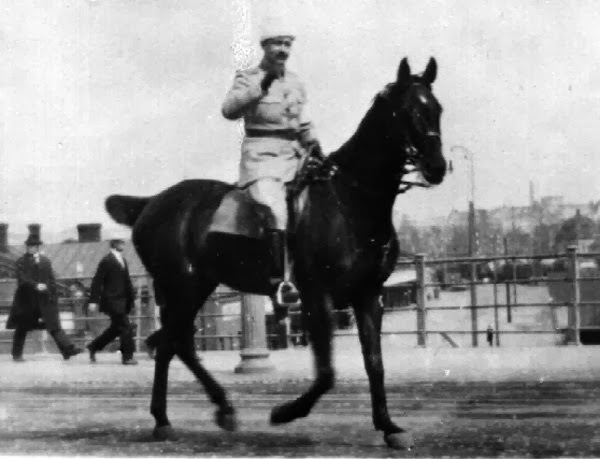
Mannerheim was the General of the Cavalry, and he
loved horses throughout his life.

 
Mannerheim – the Marshal of Finland.

"With Pure Arms"


Of course, Mannerheim wasn't perfect human and he also made some mistakes. We must still realize that during World War II, he was an old guy already: over 70 years old. At that time, Mannerheim's "right hand" was the Lieutenant General Aksel Airo (1898-1985), a main strategic planner during the Winter War and the Continuation War. Airo was the virtual second-in-command of the Finnish Army under Field Marshal Mannerheim.

One more thing about World War II: The Finnish Army didn't take part in the Siege of Leningrad (St. Petersburg). It never shot artillery fire at Leningrad nor did it bomb the city. Mannerheim refused the offers of the Germans. Finland didn't even cut supply lines of the city. I think Mannerheim didn't want to participate in the destruction of his former hometown.

Mannerheim's Latin motto was: "Candida pro causa ense candido" (With pure arms for a pure cause). This sums up the ideal towards which he strove in everything that he did.

After leaving Presidency in 1946, Mannerheim spent his last years in quiet retirement, the summers in Finland and the winters in Switzerland. He died in Lausanne, Switzerland, on January 28th 1951, at the age of 83. He was buried with full honors in Helsinki, Finland, on February 4th.

Innumerable books have been written about Mannerheim. If you want to read one good book, I recommend the book called Mannerheim by  J. E. O. Screen (2000). Screen was a British historian who had an objective attitude towards Mannerheim.

Teisuka
museum assistant


References

  • Mannerheim, Muistelmat [Memoirs] (1951)
  • Pekka Nieminen, Päämaja Seinäjoella 1918 [The Headquarters in Seinäjoki in 1918] (2013)
  • J. E. O. Screen, Mannerheim (2000)
  • Paavo Suoninen, Mannerheim – suurin suomalainen [Mannerheim – the Greatest Finn] (2007)
  • The Mannerheim Museum Website, The Marshal of Finland
  • Леонид Власов, «Маннергейм в Санкт-Петербург 1887-1904» [Leonid Vlasov, Mannerheim in Saint Petersburg 1887-1904] (1994)
  • Wikipedia articles (Carl Gustaf Emil Mannerheim, The Finnish Civil War, The Continuation War, The Winter War, etc.)

The Soviet propaganda poster from 1940. This poster claims
that Mannerheim is a murderer, an executioner of the working
class, a minion of the "Bloody Nicholas" (Russian Tsar)  and
so on. Not so nice nicknames, but the communists hated
Mannerheim – and he hated communism.

The White General covered in snow. The world's first "not-abstract"
Mannerheim statue is in Seinäjoki. The statue is designed by Lauri
Leppänen, unveiled in 1955. Photo by Teisuka (November 24, 2013).